Thailand commits to serve as bridge between Myanmar and ASEAN
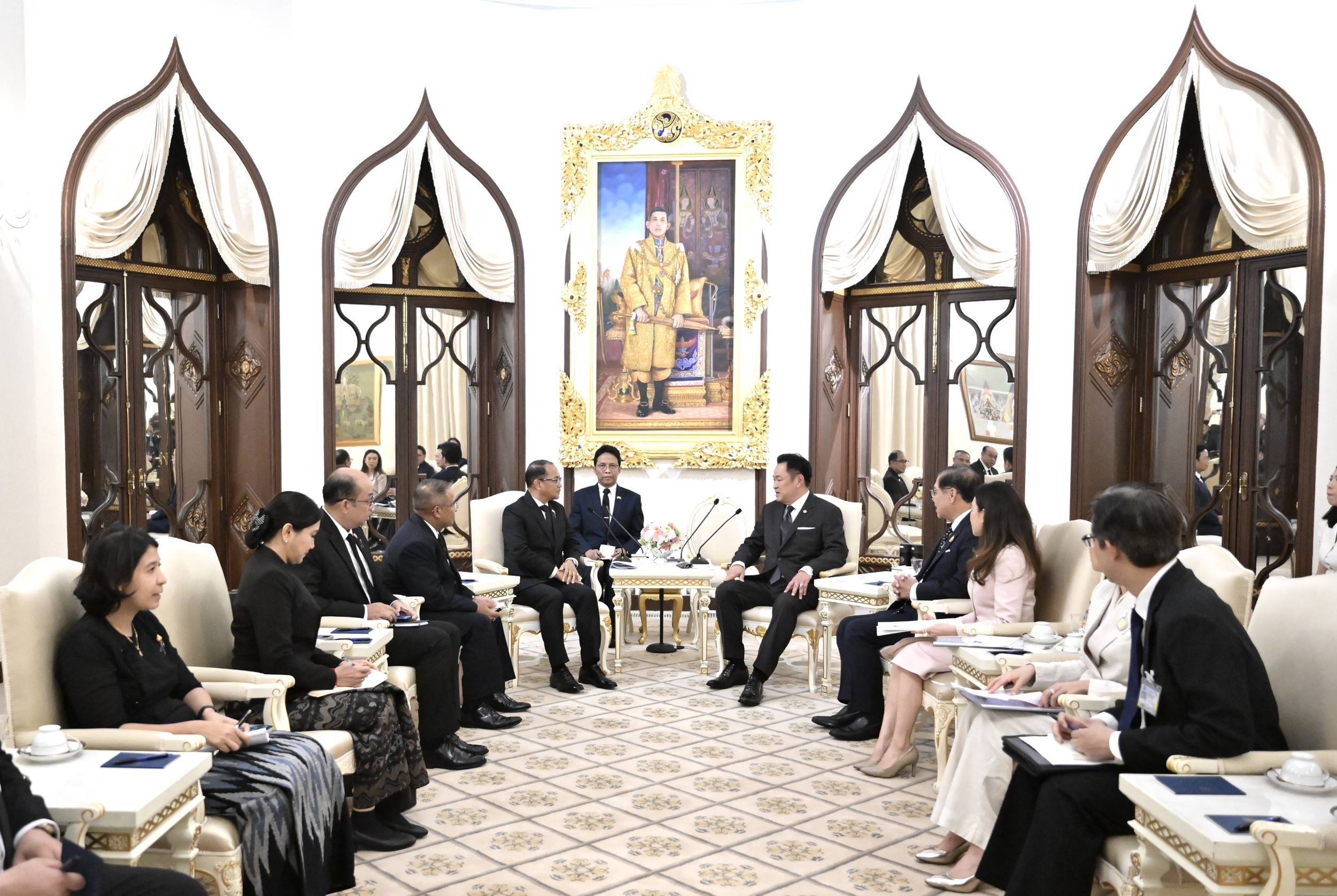
July 14, 2026, at 1600hrs, at the Ivory Room, Thai Khu Fah Building, Government House, Government Spokesperson Rachada Dhnadirek disclosed that H.E. Mr. Tin Maung Swe, Minister of Foreign Affairs of the Republic of the Union of Myanmar, paid a courtesy call on Prime Minister and Minister of Interior Anutin Charnvirakul on occasion of his official visit to Thailand. The two sides discussed reinforcing Thailand-Myanmar relations and advancing cooperation in the areas that directly benefit security, economy, and quality of life of the people of both countries.
According to the Prime Minister, Thailand and Myanmar are neighbors that share the border and both are members of the ASEAN family. Major issues affecting the Thai people, be it narcotics, transnational crime, cross-border haze, or impacts from the border situations, cannot be solved by either country alone, but require genuine cooperation between both sides.
The Thai Government is ready to serve as a bridge between Myanmar and ASEAN to pave way for constructive dialogue and cooperation. Thailand believes that a stable Myanmar, who is able to work more closely with ASEAN member states, will help address cross-border problems affecting the Thai people and strengthen peace and security in the region as a whole. The Prime Minister also took the opportunity to invite Senior General Min Aung Hlaing, President of Myanmar, to pay an official visit to Thailand to continue discussion and cooperation on matters of mutual interest.
Both sides agreed to expedite cooperation in 3 key areas:
First, border stability. The Prime Minister urged Myanmar to intensify efforts against narcotics, illegal gambling, and transnational crime, as well as to reduce burning that cause cross-border haze, and mitigate the impact of clashes and conflicts along the border. Suppression of narcotics is made a national agenda because it directly affects safety of the Thai people. Myanmar acknowledged the impact of these issues on Thailand and expressed readiness to address narcotics, illegal gambling, and other border issues, while coordinating closely with Thailand.
Second, economic and development cooperation. If the border areas are peaceful and stable, trade, investment, transportation, and border economic development will prosper, which will benefit entrepreneurs and people of both countries. Thailand is willing to share agricultural expertise, particularly in crop rotation and farmland management, to help reduce agricultural burning and alleviate cross-border haze.
Myanmar’s Foreign Minister agreed that solving haze problems requires area development, farmer education, and academic cooperation, and thanked the Thai Government for its readiness to support knowledge transfer and capacity building in these areas.
Third, Myanmar’s role in ASEAN. Thailand commits to continuing to communicate and consult with Myanmar with the belief that Myanmar’s participation in the ASEAN community will foster a cooperative atmosphere. It will also create opportunities for all concerned parties to work together in addressing regional challenges in an effective manner. Myanmar’s Foreign Minister expressed gratitude to Thailand for prioritizing Myanmar and supporting its participation within the ASEAN framework. He affirmed that Myanmar will continue its cooperation with Thailand in all dimensions as a good neighbor.